

Optocycle and Feess have been improving material purity with automation for two years


Originally, the business administration graduate had been working on a solution for food retailers in 2020 that would have scanned fruit and vegetables to save cashiers from having to type in product numbers and codes. But when the then 25-year-old told an acquaintance from the recycling industry about his technology, which he had developed with his co-partner, computer scientist Lars Wolff, the acquaintance put him in touch with the Heinrich Feess GmbH & Co KG, a construction waste recycler based in Kirchheim/Teck in Germany.
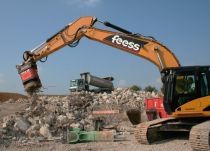
Walter Feeß had received the German Environmental Award in 2016 for his consistent circular economy strategy of processing construction waste into recycled material that is mixed with concrete, and he is still considered a pioneer in the industry today. Feess currently operates six recycling centers and storage sites in the Stuttgart region, where the delivered construction waste or excavated soil is processed into around 50 high-quality RC building materials.
In Eberhard Fritz, material flow manager at Feess, Max Gerken found his congenial sparring partner there in 2022. Geologist Fritz introduced Optocycle founder Gerken to the details of the industry and fed his database with all kinds of materials found in construction waste, which were photographed and classified from all angles so that the AI archive could learn to identify the different materials – including their composition, grain size, edge length, and degree of contamination.
Soon after, the first camera was installed above the truck scales that all trucks pass at the entrance to the recycling center. Since then, the images have been transferred to the server in Tübingen in real time and evaluated. At the same time, the weighing master performs a visual inspection from his test bench above the truck. Since March 2025, a new camera has been in operation, delivering even more precise images and supported by a spotlight to provide accurate images even at dusk, for example.
Gerken: “We have also taught the image recognition system how the appearance of materials changes when they are wet, when the sun is shining on them, or when the truck is standing in the shade on the weighbridge.” Since then, the camera has replaced the visual inspection by the weighmaster and categorizes grain sizes down to 0.2 mm. This has another advantage: since Feess currently has six recycling centers, the technology will be able to standardize visual inspections in the future. Experience has shown that inexperienced and conflict-averse inspectors in particular can differ by up to 20 % in their assessments.
Optocycle has grown to 21 employees at the turn of the year, which means it has doubled in size within a year. Twelve developers work in the technical team, which is divided into three divisions: viewing, evaluation, and data provision. The cameras, each consisting of 328 individual parts, some of which are developed in-house and manufactured using 3D printers, and some of which are purchased from regional suppliers such as Ettinger, Vision Components, and Merath, are assembled in Tübingen. Gerken expects that by the end of 2026, more than 100 of his systems will be in use at recycling centers across Europe. These remain the property of the manufacturer. Users pay a one-time installation fee and a monthly fee for use.
At Feess, people still assign the calculated item numbers for the individual batches. In the future, however, this step could also be digitized. Eberhard Fritz, who is inspired by the technology in his visions of automation and precision, is also helping Gerken to advance in the diversity of its applications. The geologist says: “Ideally, we would use the cameras at the demolition site when loading the trucks; the AI would tell the driver where to go to unload based on his load and create the digital delivery note.”
Given that 230 million t of mineral construction waste, ranging from concrete and bricks to ceramics and tiles, are generated each year in Germany alone, Optocyle’s shareholders see a huge growth market ahead of them. This corresponds to a good half of the total waste disposal volume and fits in well with the circular trend topic of “urban mining”, which views buildings as material stores. These stocks are already being recorded on digital platforms such as Madaster or Concular and can also be stored in material lists for new buildings via BIM. Gravel, sand, and clay from excavated soil are added to these volumes.
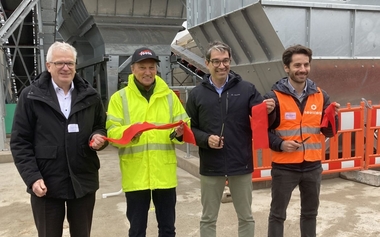
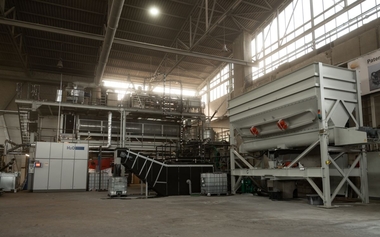
At the same time, Gerken and Wolff, who have received generous government funding and research grants, are already testing an initial application for the acceptance of biowaste in bio-waste treatment plants. The founders do not yet see any competitors in this market for material flow acceptance. So far, they have all concentrated on identifying contaminants within sorting plants. Feess will also be implementing such an application in the near future at its site in Kirchheim/Teck – with Optocycle. For the past year, a gigantic sorting plant has been in operation here, which will ideally handle all mineral demolition waste, i.e., classic construction waste, in the future. Fritz says: “Sort purity in delivery will then no longer be the central issue.”
At the same time, the material flow manager has been observing a growing awareness in the industry over the past ten years of the importance of sorting by type during demolition in order to close cycles and massively reduce disposal costs. He sees the AI-supported camera technology used by his service provider as offering a 20 % improvement in quality compared to the human eye – and a cost saving or the prospect of higher revenues.
He also wants to work with Gerken to develop a solution that allows cameras to compare the “tipping moment”, i.e., the unloading, with the recording of the load at the entrance beforehand, “to see if it really contains what we assumed.” This will make suppliers more aware of the importance of sorting waste by type, because “there is a huge difference in cost between having to pay per ton for disposal and receiving money for delivering recyclable materials.”