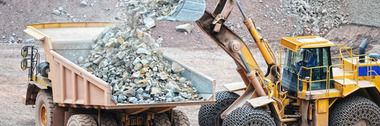


Real-time material flow in mining, steel and chemical operations
 © Sachtleben Technology GmbH
 © Sachtleben Technology GmbH
 © Sachtleben Technology GmbH


 © Sachtleben Technology GmbH
 © Sachtleben Technology GmbH

 © Sachtleben Technology GmbH
 © Sachtleben Technology GmbH
Summary: Mining, steel and chemical processing are the heavy weights of bulk material handling. Thousands of tons of ore, slag, limestone, salt or fertiliser are moved, stored and processed every day. The economic value lies literally in the mass that has to flow – yet in many plants, inventory and throughput figures are still based on truck counts, bucket factors or the experience of individual operators. With the LiDAR platform OWL EYE® from Sachtleben Technology GmbH, this becomes an end-to-end digital process – robust, ATEX-capable and integrable into any control system via REST API or OPC UA. The article explains how the modular LiDAR platform OWL EYE® non-contact measures stockpiles, conveyor belts, bins and silos in tough industrial environments – and sustainably optimises processing and logistics.
1 Bulk material processes between geology
and just-in-time
Whether iron ore, copper concentrate, limestone, slag, potash or fertiliser granules – they all share one feature: they have to be mined, transported, temporarily stored and processed in very large quantities. Time lags between mine, processing plant and gate are inevitable: blasting and haulage shifts work in waves, processing and shipping capacities are limited, unplanned downtime is the rule rather than the exception. The consequences are well known: temporary stockpile build-ups, mills running short, freighters waiting for loading, bins overflowing or running dry.
Precise and continuous quantity measurement creates the transparency that data-driven decisions require: when is another wheel loader needed, when should blend ratios be adjusted, when does the next shift start, when should loading for the next vessel be prepared? Exactly this transparency is what OWL EYE® delivers – from the quarry face all the way to dispatch.
2 One platform, many modules
OWL EYE® is designed as a modular solution. Instead of a specialised laser for every application, the system combines sensor-agnostic 3D and 2D LiDAR sensors with a unified analytics and visualisation layer. Data from the individual modules flows into a single browser-based dashboard and can be passed on to existing systems via REST API, OPC UA, analog outputs and SAP/Power BI interfaces. The most important building blocks at a glance:
Static stockpile measurement using permanently installed 3D LiDAR sensors on masts or buildings (>98 % accuracy)
Mobile stockpile measurement via sensors on wheel loaders, stackers, bucket-wheel excavators or drones
Bin, silo and hopper monitoring including detection of bridging and dead inventory
Non-contact volume flow measurement on conveyor belts as alternative or supplement to belt scales (±1 %)
OWL EYE® Inspect for conveyor diagnostics and foreign object detection
Static high-precision Riegl scanner surveys for inventory and compliance reporting
3 Mining and quarry application – from inventory to just-in-time feeding
In mining and quarry operations, inventory and shift reporting have always involved considerable manual effort. Surveyors climb on stockpiles with a total station, GPS rover or drone; the data ends up in Excel and often only appears in the report days later. With OWL EYE®, this effort disappears: several permanently installed 3D LiDAR sensors continuously cover stockpiles over hundreds of meters. Feed hoppers, primary crushers and feed chutes are monitored on top and deliver real-time fill levels directly to the control system.
Particularly valuable is the ability to separate stockpiles by material quality: where is high-grade ore stored, where is contaminated material located, where has fresh material just been tipped? The software subdivides the digital pile into three-dimensional cubes and can assign arbitrary information – sample number, delivery date, analysis result – to every cube. As a result, the wheel-loader driver is guided via tablet to exactly the area whose material is currently required, ensuring a constant feed quality in the processing plant.
In parallel, volume flow measurement on the conveyor belts to the processing plant delivers continuous throughput values. Compared to classic belt scales, the system scores with lower maintenance, easy retrofit and complete wear-free operation – a major advantage in dusty, abrasive environments.
4 Steel application – slag, scrap and feed bins
In steel plants, iron ore, coke, lime, scrap and slag dominate the material flow. Slags from the converter or electric arc furnace process in particular have to be moved quickly and safely from the steelworks to the processing area, where they are measured, classified and stored. The conditions are extreme: high temperatures, lots of dust, vibration-loaded structures and material shapes ranging from fine granulate to slag boulders of more than a meter.
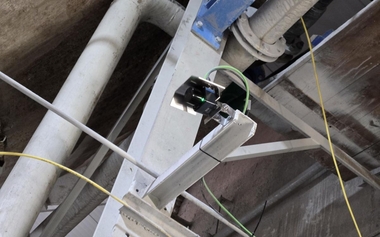
OWL EYE® sensors are deployed here in IP65+ housings and with automatic compressed-air cleaning. In applications with wireless data transmission, the measuring station can also be operated where cabling is economically unfeasible – for example on mobile slag tipping areas or in temporary storage zones. Integrated weather sensing can also capture wind, temperature and precipitation, which helps later analyses of drying and solidification processes.
The result is an end-to-end digital material balance from the converter through the slag yard to the saleable product. Complaints can be traced back to batch and delivery day, processing plants can be tuned to actual demand and maintenance windows can be planned precisely.
5 Chemical application – salt, fertiliser and ATEX environments
In the chemical industry, the processing of salts, fertilisers and granulates plays a central role. Plants for potash, rock salt or multi-nutrient fertiliser process several thousand tons of material every day in partly highly corrosive, dusty and explosion-prone environments. Classic optical and mechanical measuring techniques quickly hit their limits here – due to wear, build-up or because they are problematic from an explosion-protection point of view.
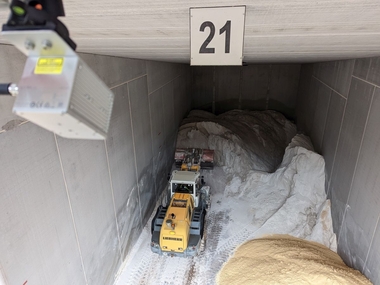
OWL EYE® offers several approaches here. For classical storage halls, 3D LiDAR sensors with a wide field of view cover complete bins and stockpiles in a single scan. For ATEX-relevant areas, explosion-protected housings are available. For applications in which sticky or moist fertilisers would contaminate the sensor, the compressed-air cleaning is individually tuned to the material – verified in dust chamber tests at Sachtleben Technology.
During operation, the system not only records inventory but also supports cleaning and handling logistics. As soon as an area is being reclaimed, cleaning progress can be visualised, residual quantities quantified and the next loading task planned. This considerably reduces manual coordination between shift and logistics teams.
6 OWL EYE® Inspect – more than tons per hour
The OWL EYE® Inspect module extends pure quantity measurement with an intelligent diagnostic layer. From the cross-sectional profiles that are already there, anomalies are detected in real time – from shifted mass centres to large foreign objects, incipient belt damage or material build-up. Especially in applications with expensive downstream equipment (mills, crushers, classifiers, pelletising presses), the early-warning system pays for itself: a single undetected steel boulder in a hammer mill can cause six-figure damage and days of downtime.
All events are archived in the system with time stamp, belt position and profile image. Over time, this creates a valuable data basis for predictive maintenance. Instead of rigid intervals based on hours or tonnage, the team can intervene precisely where damage is imminent.
7 Integration into processing, logistics and plant IT
OWL EYE® has been designed as an open system from the very beginning. Via REST API, OPC UA and analog outputs, all measurement values are available to existing process control, MES and ERP systems. SAP and Power BI connections are part of the standard scope, just like configurable e-mail notifications for threshold violations or plausibility deviations. In pilot projects with partners such as Axians IAS, OWL EYE® is already being combined with yard management solutions – for example to automatically select the optimum loading point or to control conveyor belts for precise truck loading.
The modular philosophy allows a step-by-step expansion. Many plants start with a single volume flow measurement or one stockpile, later add further measuring points and finally integrate Inspect and inventory functions. In this way, the return on investment can be proven for every expansion step individually – an important argument for investment decisions in a conservative industrial environment.
8 Profitability, sustainability and conclusion
Precise material flow measurement pays off twice in heavy industry: on one hand through higher plant availability, lower repair costs and optimised processing, on the other hand through an honest CO₂ and energy balance. Anyone able to control plant inventories precisely can avoid unfavourable transport routes – for example when the Rhine water level is too low for barge navigation and material would otherwise have to be moved by truck. The OWL EYE® platform from Sachtleben Technology GmbH delivers the necessary data basis – non-contact, robust and seamlessly integrated. From quarry to dispatch, from slag yard to fertiliser silo, from a single measuring point to fully digitised plant logistics.