

Blower technology optimised to ATEX guidelines
The transport of fine bulk materials is often a balancing act between logistical efficiency and technical risk. Where dry particles are moved at high speeds, the danger of a dust explosion is ever-present. To manage these risks reliably, Continental Industrie relies on blower technology that, through mechanical decoupling and oil-free compression, nips the formation of ignition sources in the bud.
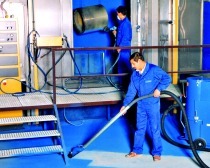
 One of the rare inspections of ATEX-certified centrifugal blowers. Thanks to its oil-free and robust design, Continental Industrie’s solution for bulk materials in potentially explosive atmospheres requires no maintenance cycles
© Continental Industrie GmbH
In the bulk materials industry, explosion protection dictates the framework for every process. In particular, the handling of ultra-fine dust materials requires systems that present no ignition source, even under extreme conditions. Here, the company draws on expertise refined over three decades: the centrifugal blowers from Dormagen are consistently optimised to meet ATEX directives and specifically certified for Zones 21 and 22. The result is a pulsation-free material flow that safeguards the purity of the medium through a guaranteed oil-free operation.
Safety through structural separation
The superiority of the ATEX blowers is evident in the details of their design. Whilst conventional systems often struggle with premature wear, the manufacturer employs a vertical design with an external bearing housing. This design is far more than just a stylistic feature: it mechanically decouples the critical functional components from the conveyed medium. Manufactured from high-quality aluminium or grey cast iron, the moving parts remain protected from direct contact with the bulk material – a crucial factor in achieving service lives that are significantly above the market average.
Maintenance efficiency as a competitive advantage
Downtime is the biggest cost driver in modern logistics. A system for continuous bearing lubrication, which carries out maintenance fully automatically during operation, helps to prevent unplanned stoppages. This “non-stop” approach also continues in the event of servicing: the well-thought-out layout allows bearings to be replaced without having to dismantle the entire blower unit. This radical simplification of maintenance reduces the time required to a minimum and noticeably eases the workload on specialist staff.
Smooth operation through physical precision
“In practice, centrifugal blowers often prove to be the more far-sighted choice compared to conventional rotary lobe blowers,” emphasises Managing Director Tobias Boeckh. The reason lies in physics: aluminium impellers with low mass inertia ensure low-vibration operation, which is maintained even at high flow rates. In an industry where noise protection and reducing mechanical stress on the entire system are becoming increasingly important, this quiet operation offers a clear operational advantage.
With over ten model series, Continental Industrie now offers a technological range that can be precisely tailored to the specific pressures and volumes of modern bulk material handling systems. Safety, efficiency and durability thus come together in a single solution, freeing up the mind to focus on the actual core business.
Principles of pneumatic conveying
Pneumatic conveying uses air as a means of transport to move bulk materials by means of positive or negative pressure. Depending on the system design, different units are used:
• Positive pressure conveying: Centrifugal blowers generate a positive pressure of up to 1000 mbar to propel the material.
• Suction conveying: Exhaustors generate a negative pressure of up to 500 mbar to draw in the material.
A key aspect of this is fluidisation: a uniform air flow makes the bulk material free-flowing, enabling it to flow smoothly out of containers and be transported away. As these processes often create atmospheres at risk of dust explosions, an ATEX-certified version of the blowers is essential in many applications.