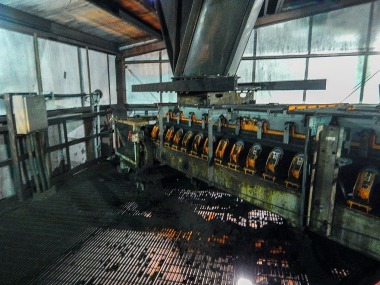


Conveyor dribble chutes for better material flow
 © Martin Engineering
 © Martin Engineering
 © Martin Engineering
 © Martin Engineering
 © Martin Engineering
 © Martin Engineering
Carryback on conveyor belts causes dust, spills, and material loss, shortens the service life of the belt and rollers, and increases maintenance costs. The following article presents possible solutions to avoid these problems. Updating efficient conveyor discharge equipment can increase the volume of fines cleaned from the belt and may require a specific accessory called a dribble chute, particularly in slurry or sludge applications.
As belt conveyor cargo travels over the idlers on the carry run, the weight of the cargo and the undulating surface causes dust and fines to adhere to the belt and lodge into cracks and gouges. Upon discharge, material that does not fall with the main cargo stream and remains clinging to the belt’s return is known as “carryback”. If it is not cleaned from the belt by a primary and secondary cleaner, the carryback falls from the belt and accumulates in piles under the belt, building up as spillage or becoming airborne dust (Fig. 1). Studies have shown that mitigating carryback can reduce fugitive spillage and dust by up to 90 % while increasing idler and belt life by 25 to 30 % [1].
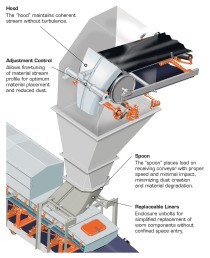
Material that is cleared by a primary or secondary cleaner is collected on a slope in the rear of the head chute called a “dribble chute”. However, cleaning these fines increases the volume of material passing through the head chute and can build up directly under the head pulley. To control buildup and chute clogging, a vibrating dribble chute and mounted air cannons were developed to reduce downtime from clogging and cleaning and increase production.
A clean belt is an efficient belt
If a belt has no cleaners, operators should expect to add labor to their budgets to clean spillage and replace fouled components from excessive dust and carryback. When spillage is left to build up, the belt rides on the dried pile of abrasive material which prematurely erodes the belt covers and damages the unprotected return resulting in a lower belt life (Fig. 2). Further down the return path, carryback can foul rollers and spills into walkways requiring regular maintenance to retain efficiency and adequate workplace safety standards.
Without adequate cleaning, a belt in a heavy-duty dry bulk handling operation can carryback more than 0.45 tonnes of material per hour. The addition of just a primary cleaner will still experience carryback, leaving only an average of 100 g/m2 on the belt. Adding multiple cleaners can get the carryback level down to 50 to 20 g/m2) on the belt. Depending on the speed of the belt, length of the system and the space in which it is operating, this amount of average carryback would keep spillage levels sustainable and dust levels relatively compliant to workplace air quality regulations.
Using a high quality belt cleaning system drastically reduces carryback, dust and spillage, but also introduces a design dilemma resulting in faster build up on the dribble chute. Depending on the characteristics of the application, the design of the dribble chute is an important consideration. Material buildup on them requires addressing to maximize production efficiency [2].
Some heavy-duty applications might require two primary cleaners and a secondary cleaner between the discharge and snub pulleys which can result in a lot of buildup. Due to space restrictions from a small head pulley, tertiary cleaners might be the only option, so designers recommend a vertical dribble chute. Vertical dribble chutes are also prone to buildup and clogging and are difficult to clean. If only a tertiary cleaner is allowed, catch pans are often used to gather carryback from idlers when the conveyor path crosses environmentally sensitive areas, roads or walkways (Fig. 3).
Dribble chutes: Catch or release?
Some methods of controlling carryback capture the material for cleanup and others aid flow and release it back into the cargo stream. Capture systems such as drip pans or catch pans are often designed to be lowered or hinged making cleanup faster but still expose the worker to hazards as large build ups can break loose while cleaning (Fig. 4).
Instead of catch pans, some systems allow material to drop below the system and are cleared by drag chain or pusher conveyor. These can be effective in operations with larger aggregate but may run into issues if loads are unbalanced or moist fines are left to harden during downtime. Operators who use this method have reported that the extra power required to run these systems is costly and more labor is needed to keep systems functioning than they previously predicted.
The most basic flow aid is the use of water to saturate the discharge and keep it flowing onto the receiving belt. Although some applications can attribute silica content, magnetic properties and surface friction for buildup, moisture is a large factor in adhesion (buildup on surfaces) and cohesion (buildup of material upon itself). Most bulk solids begin to lose adhesion strength at 15 % moisture, so not using enough water makes the carryback stickier, whereas oversaturation could cause problems since many processes cannot tolerate the addition of water.
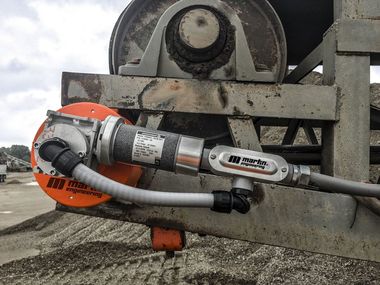
One highly effective and field proven method is installing a sloped chute with a low friction “active” surface. A vibrating dribble chute is a vibrator attached to a floating low friction liner to make the surface active using vibration and gravity to move the material toward the discharge stream (Fig. 5). In some cases, whole chutes can be isolated to make the applied vibration more effective.
Air cannons for transfer chutes
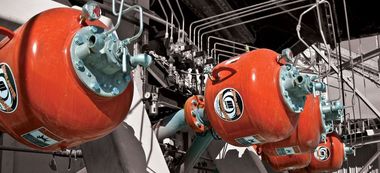
Air cannons have demonstrated to be highly effective for aiding flow and eliminating clogging of difficult materials in large chutes. The benefit of air cannons is that, when properly mounted, they dislodge material in typical buildup prone areas such as corners and low angle surfaces. Air cannons release pulses of compressed air to shear buildup from surfaces. They are simple devices with one moving part that only requires compressed air and a trigger method. The cannons can be discharged manually as needed or on a timed sequence (Fig. 6).
The cannons are pointed in the direction of the cargo flow providing consistent and efficient production. Firing sequences are accomplished with a simple timer set at an interval based on the cycles of material flow. Intervals can be fine-tuned for fluctuations in humidity or freezing where clogging is more prevalent, or during changes in volume, material type or belt speed, when added flow aids are required. Adjustments to firing sequences are accomplished manually by a nearby solenoid box or can be routed to a centralized logistical system.
Another use of air cannons on dribble chutes is to angle the nozzle downward behind a heavy flexible curtain that ripples when the air cannon is fired, dislodging the adhered material from the surface. Ideally, the curtain would be made from a rubber material with a slick low-friction face that is easily replaceable once it is worn.
Conclusion
Problems associated with carryback such as cleaning spillage, clearing buildups and unclogging chutes used to be considered a cost of doing business. For operators experiencing excessive buildup from carryback, labor costs and workplace safety concerns might require a review of the discharge zone design of their belt conveyors.
Over time, when calculating for labor and lost production, unplanned outages to manually clean spillage can justify the cost of a total discharge zone redesign. This includes a larger head pulley, the adequate number of cleaners for the application, and a complete transfer chute configuration with flow aids. Using proven flow technology like a vibrating dribble chute and air cannons working in tandem will promote more uptime and greater production. For more details, please see this Dribble Chute Tutorial [3].
Literature
[1] Swinderman, R. Todd; Stahura Sr., Richard P.; Marshall, Daniel; et al: FOUNDATIONS – The Practical Resource for Cleaner, Safer,
More Productive Dust & Material Control; Fourth Edition; page 197; Martin Engineering; Worzalla Publishing Company; Stevens Point, Wisconsin 2009. https://foundations.martin-eng.com/book-form-download-page
[2] Swinderman, R. Todd; Stahura Sr., Richard P.; Marshall, Daniel; et al: FOUNDATIONS – The Practical Resource for Cleaner, Safer, More Productive Dust & Material Control; Fourth Edition; page 227; Martin Engineering; Worzalla Publishing Company; Stevens Point, Wisconsin 2009. https://foundations.martin-eng.com/book-form-download-page
[3] Swinderman, R. Todd, Dribble Chutes, Video Tutorial. https://foundations.martin-eng.com/en-us/webinars-on-demand#carryback&beltcleaning