

Over 40 % lower process costs thanks to modern crossflow filtration




Success story: How SCHAEFER KALK, a long-established company based in Diez/Germany, reduced its process costs by 42 % with the help of dynamic crossflow filters from BOKELA, while also making a lasting contribution to protecting the environment. With a ROI of just under three years, the project also serves as a blueprint for other industries.
Founded in 1860, SCHAEFER KALK is a family business currently run by the 5th generation. It employs around 700 people worldwide and is a manufacturer and supplier of high-quality burnt and unburnt lime products, as well as Precipitated Calcium Carbonate (PCC). Using one of the purest limestone deposits in Europe, the company produces high-quality lime and meets a wide range of customer specifications and individual requirements. SCHAEFER KALK has developed into a PCC product specialist and supports customers worldwide in the further development of their products or the creation of new ones through its own laboratory.
For the paper industry, SCHAEFER KALK produces, among other things, fine-grained calcium carbonate, which, after production, is used in further processing or transport at a suspension concentration of 18 wt-%. Until now, 7 truckloads per day were required to meet the daily production volume of a paper mill in China. The resulting tasks were therefore to reduce transport volumes by increasing the final concentration, improving product properties for further processing, and achieving a filtrate that was as particle-free as possible.
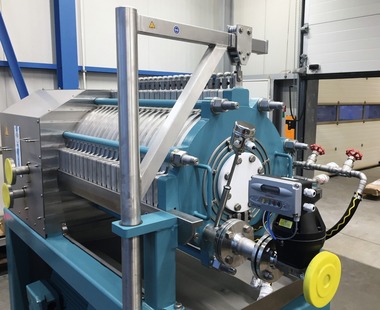
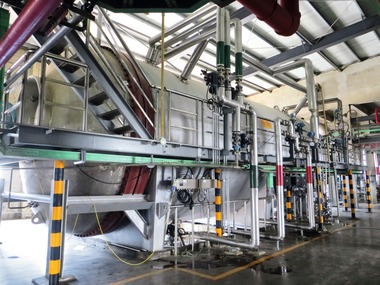
In BOKELA, they found a partner who understood their precise filtration requirements and was able to offer a customised solution. The German company, based in Karlsruhe and specialising in solid-liquid separation, supplies a wide range of filtration solutions for chemical, pharmaceutical and mining processes around the world. In the case of SCHAEFER KALK, this is the BoCross Dynamic, a membrane filter for the rapid and gentle concentration of microfine to nanoscale suspensions.
Using this upstream crossflow filter has reduced the water content of the transported volume by almost half. This means that only around four trucks are now needed each day to transport the cargo, which has a weight percentage of 30 %. In principle, an even higher concentration would be possible, but this would negatively impact the unloading process due to increased viscosity.
Instead of 60 000 m³/a, only 33 000 m³ are now transported, leading to a direct reduction in costs. Additionally, reduced diesel consumption (minus the electricity consumption for concentration) saves almost 100 t of CO₂/a. Another significant consequence is the recovery of around 27 000 m³ of clear filtrate per year, which can be returned directly to the process.
Ultimately, the additional filtration step was found to be cost-effective, with the savings in transport outweighing the additional energy, maintenance, and capital costs by a payback period of only 2.9 years.
Production and utilisation of PCC
Precipitated Calcium Carbonate (PCC) is used wherever high chemical purity, perfect white pigmentation, high opacity, the finest possible particle size, a narrow particle size distribution and precisely defined crystal structures are required for flawless results.
To produce PCC, carbon dioxide gas is infused into lime milk. This creates a watery suspension that is filtered, dried and ground to produce the desired end product. Different crystal structures, particle shapes and sizes will develop depending on the type of precipitation vessel and the process implementation. It is these subtle changes that make such a wide range of products possible.
PCC differs in its properties from naturally occurring calcium carbonate. It is used as a filler in tablets, as a calcium source in food and dietary supplements, as an additive in paper and plastics manufacturing, and as a white pigment extender in emulsion paints.
How BoCross filters work
The BoCross Dynamic filter uses dynamic crossflow filtration for the microfiltration and ultrafiltration of microfine to nanoscale suspensions. The dynamic shear gap principle ensures ideal physical conditions for the separation process. Under the influence of shear forces, the concentrate remains fluid even at high concentrations. This means that highly viscous and concentrated suspensions can be processed effectively. Compared to conventional crossflow filtration, the BoCross Dynamic filter achieves concentrations that are several times higher.
BOKELA at FILTECH 2026
From 30 June to 2 July 2026, BOKELA will be presenting its filtration solutions at FILTECH, the largest and most important trade fair for filtration, in Cologne/Germany, in Hall 8 at booth A45. Free personal ticket are available at sales@bokela.com.