
GIPO installs bespoke crushing plant at ROHRDORFER ZEMENT GmbH


The Rohrdorfer Group’s two sites in Upper Austria have a long history: the cement works in Gmunden began operations as early as 1908 and was initially supplied with calcareous sandstone from the nearby quarry. However, it soon became apparent that the desired material was not available in sufficient quantities or of the required quality at that site. Consequently, as early as 1910, operations moved to Ebensee, 20 km away, where limestone quarrying began.
Following a war-related interruption, cement production rose steadily after the war, meaning that increasing quantities of limestone were quarried from Ebensee and transported to the plant. The cement works was run by the Hatschek family until 2004, after which it was taken over by ROHRDORFER ZEMENT GmbH. The Rohrdorfer Group employs around 2100 people and operates 160 sites in Germany, Austria, Italy and Hungary, where it regularly invests in modern technology.
New primary crushing plant at the Ebensee quarry
The quantities extracted in Ebensee have risen over the years to an average of 500 000 t. A record output of 600 000 t was achieved in 2021. These figures make it clear that the primary crusher, as the heart of the plant, must operate smoothly to ensure that the processes of blasting, crushing and removal run efficiently in well-organised cycles. Today, the Gmunden cement works employs around 140 staff and approximately 10 apprentices. The cement works is supplied from the Ebensee quarry via conveyor belts and rail transport; 10 staff members are employed there.
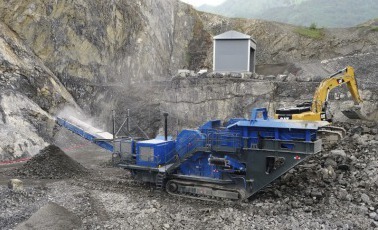
Melanie Lettner is the head of the department responsible for the quarries in Gmunden and Ebensee and oversees the extraction of raw materials as well as raw material planning and procurement. Christian Grabner is a project manager and works in maintenance planning. He oversaw the procurement of the new primary crushing plant for the Ebensee quarry from the initial discussion with Jesse Gasser, a field sales representative at GIPO, right through to its joint commissioning. The GIPO B 1490 has a capacity of 600 t/h with a particle size range of approx. 0 – 200 mm.
The focus is on customisation
Christian Grabner explains: “Our old primary crusher had already been in service for 28 years and had processed 12 million t of rock during that time; we now needed something new that would, however, fit well into our existing infrastructure. After making several enquiries with well-known companies, GIPO was the only company that truly responded to our wishes and ideas and did not try to sell us a system straight off the catalogue, so to speak. Furthermore, it was personally important to me that I always had one single point of contact from the planning stage right through to commissioning; this worked really well with Jesse Gasser.”
In addition, we had the opportunity beforehand to speak to other customers of the Swiss manufacturer who were already working with GIPO systems. Such transparency was very convincing. During a visit to Switzerland, the Rohrdorf project team toured GIPO’s production facilities and warehouse and were immediately convinced not only that the products were of high quality, but also by the fact, that spare parts could be supplied very quickly thanks to the extensive stock.
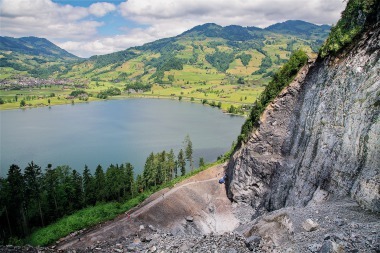
The planning phase presented a number of challenges: the quarry is situated very high up on the mountain. There was very little space available there to position the machinery. All the components of the plant, weighing around 200 t, had to be transported there in a logistical feat: the crusher drove itself up the mountain to an altitude of 730 m with the aid of a portable 300 PS diesel generator.
Client requirements
One requirement for the plant was that it could be configured in three different layouts, so that it could be relocated to another site in approximately eight years’ time. Furthermore, a roller screen was requested to reliably screen out small material particles upstream of the crusher, ensuring that only material to be crushed passes through the jaw crusher with an inlet size of 1330 x 900 mm. The feeder, which can handle material from two different bucket sizes, ensures a continuous feed to the crusher and thus a continuous flow of material. “Our aim is always to design our plants in such a way that they fully meet the requirements of the material recipient,” explains Jesse Gasser.
It was also important to the clients that no electrical components were mounted directly on the plant. Only the necessary motors and sensors are located there, whilst the electronics are securely housed in a container next to the plant and are thus protected from vibrations and external influences. GIPO also implemented this requirement, thereby preventing malfunctions and downtime at the plant.
Furthermore, GIPO implemented a key requirement in the electrical sector: that, as is standard practice within the Rohrdorfer Group, a Siemens control system be used. Through intensive coordination and collaboration, the electrical components were also successfully integrated into the existing infrastructure.
However, it was not only GIPO that had to adhere to specific requirements in Ebensee; ROHRDORFER ZEMENT GmbH, whose quarry – and thus the new crushing plant – is within sight of the village, also maintained very transparent communication with local residents throughout the project. Together with the Ebensee Citizens’ Advisory Board, measures to protect against noise and dust were defined, enabling Rohrdorfer to install noise barriers and a dust suppression system near the crushing plant.
Advantages of the plant: durable, robust, safe
Melanie Lettner sums it up: “It was important to us that GIPO was able to genuinely tailor the plant to our quarry, which now ensures not only smooth operations but also workplace safety. Because the entire plant comes from a single source, everything runs smoothly and works well together. The collaboration with GIPO has worked very well.”
It was equally important to everyone involved that all necessary measures were taken to ensure safe and convenient operation: platforms and guardrails from top to bottom are a given. But staff were also consulted on which functions should be assigned to the remote control and where, for example, the emergency stop buttons should be located. “It was also particularly important to us that all areas where regular maintenance work takes place and components are replaced are easily accessible, e. g. the motors of the hydraulic pumps or the roller bearings of the roller grate,” said Grabner. Similarly, the crusher can be moved back and forth by 20 m using electric power for cleaning purposes.
Furthermore, feeding the material onto the plate belt conveyor is gentler on the plant. Previously, everything was fed directly onto the crusher; now the impact is cushioned and, at the same time, there is less noise for local residents. In the past, during a shutdown, the crusher had to be cleared manually; with the GIPO plant, the direction of rotation can be reversed, thereby emptying it automatically.
Close coordination was essential
Despite numerous coordination meetings, the entire project was implemented very swiftly for a plant of this scale: from the initial contact on 24 June 2024, it took less than 1.5 years until acceptance at the GIPO factory, which took place on 1 December 2025. Jesse Gasser recalls: “Our aim was to have the plant up on the mountain before Christmas 2025, which was no mean feat given the Austrian winter, but the transport was completed on 18 December.”
Melanie Lettner praises the excellent support provided by local companies, which, during the preparations at the crusher site, installed 220 m³ of concrete and 25 t of reinforcing steel, as well as carrying out the necessary modifications to the existing building. “We shut down the old crusher on 1 November 2025, and then the conversion work on the mountain began.” From that point until final completion, the material required for the cement works had to be taken from the open-air storage area, so adhering to the schedule was of the utmost importance.
The final handover, including performance testing, was originally scheduled for early April 2026. This was completed a month ahead of schedule, meaning normal production has been underway since 4 March. Christian Grabner: “That went very well; we just needed to make a few adjustments between our own software and the plant’s software. Otherwise, it was really just a case of switching it on and starting production straight away. That, combined with the robust construction of the entire plant, really impressed us and our colleagues.”
Following minor adjustments, such as fitting additional metal plates designed to make day-to-day operations easier for users, the new crushing plant was officially inaugurated in early May at GIPO’s invitation, with a barbecue on the mountain attended by all those involved.
Primary crushing plant
The primary crushing plant consists of a crawler-mounted jaw crusher and a skid-mounted feeding unit. The material is continuously fed to the crusher via the feeding unit using a plate conveyor. Moist and sticky material, fine and flat particles, as well as contaminated material, are separated via the roller screen, which has a working width of 1270 mm and 10 rollers. This not only increases crushing capacity but also reduces wear and relieves the load on the jaw crusher. During the screening process, this also ensures optimal material flow and transfer to the jaw crusher. The tried-and-tested, highly robust GIPO B 1490 jaw crusher, designed for hard rock and featuring a feed opening of 1330 x 900 mm, reduces the material to a final particle size of 0/200 mm.
Technical data:
Crawler-mounted jaw crusher, type GIPO B 1490
Roller screen: width 1270 mm/10 rollers
Jaw crusher feed opening: 1330 x 900 mm
Electric drive
Jaw crusher: 160 kW
Auxiliary drives: 200 kW
Feed capacity: approx. 600 t/h
Operating weight: approx. 110 000 kg
Skid-mounted feeding unit, type GIPO PB
Feeding hopper capacity: 40 m3
Operating weight: approx. 90 t