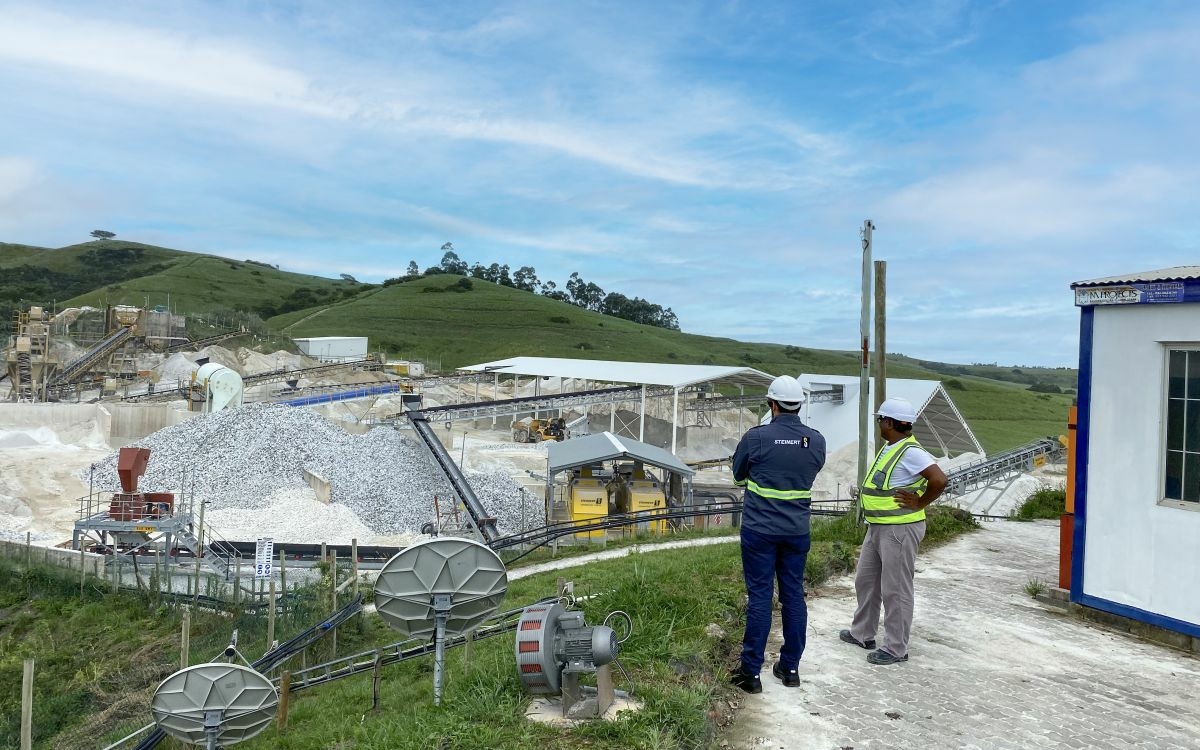


Navachab Gold Mine is investing in modernised sorting technologies – STEINERT KSS EVO 6.0
14.01.2026Navachab Gold Mine, a low-grade gold ore operation, upgrades its very low-grade ore resources using STEINERT’s suite of innovative dry sorting processes. At Navachab it has been possible to double the gold grade. As the STEINERT machines require a minimum of water the technology is very environmentally friendly. The very low operating costs (a quarter of DMS costs) and modularity make the machine very easy to integrate into existing circuits. Navachab has been using STEINERT XSS T sorters since 2016. Over the last decade, these sorters have preconcentrated over 10 million tons of low-grade stockpiles and turned it into valuable ore, which were previously considered uneconomical to process. Navachab Gold Mine has now installed the next generation of STEINERT’s sorting systems.
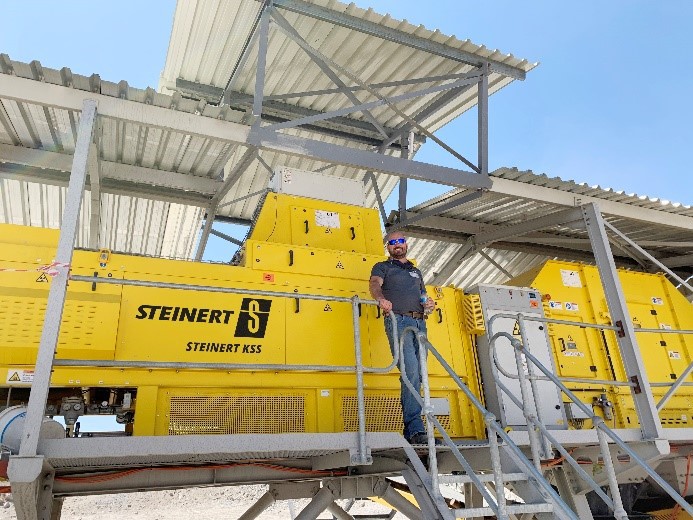
 Hildebrand Wilhelm, Project Manager at Navachab Gold Mine, is trying to responsibly treat the orebody available
© STEINERT
Friday morning 9 o’clock Swakopmund, west coast Namibia. Hildbrand Wilhelm welcomed STEINERT into his office. His role has changed – after decades of performing various senior management roles at the mine, he is now responsible for proposing the future of the mine. “As a young engineer, I was forced to question the status quo. That was how I was brought up.” This mindset was applied to the unique circumstances that Navachab Gold Mine finds itself in to create a future.
In 2024 the mine contributed meaningful percentage of the gross domestic product of Namibia. A deep understanding of the technologies and holistic thinking enables one to select promising routes of treatment. Hildebrand Wilhelms states: “The more of a holistic view you have, the better you can decide what technologies can work, as long as you understand these technologies.” The next evolution being considered is a doubling of current treatment capability. Compared to previous processes using Dense Media Separation (DMS), dry, sensor-based sorting now runs at 1/4 of the overall operational costs, while doubling throughput. For these reasons, and because this process does not require water, it plays a key role in the future.
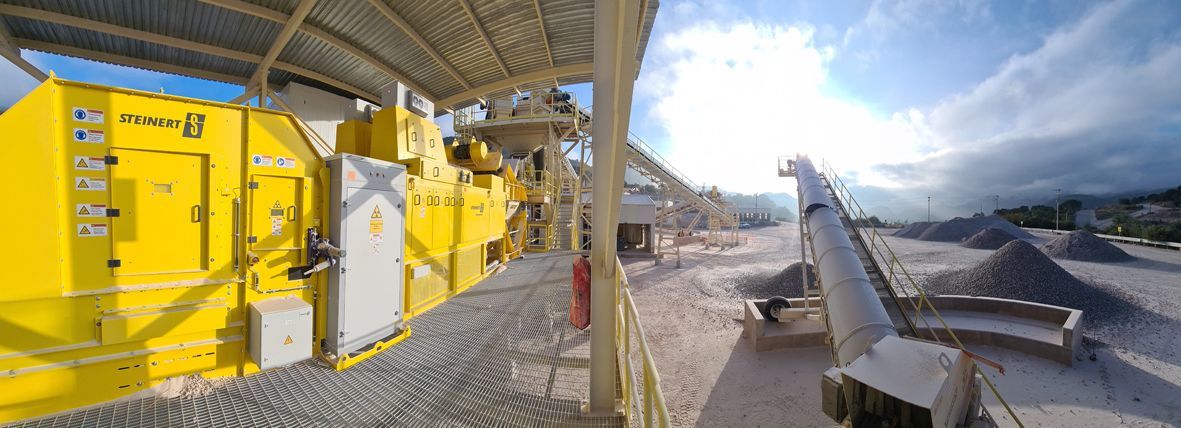
 The new STEINERT KSS comes with faster and safer service, maintenance and accessibility. Railings and ladders are now a permanent feature of the machine design and vastly improve handling
© STEINERT
From single sensor to multi-sensor sorting
The metallurgist is amazed by the detection rate per second – and the fact that the dry sorting plant sorts 200 t/h to detect material falling below the CIP plant cut-off grade. “That is where the value is generated because then – with the doubled grade – the material can be profitably treated by the downstream processes,” he emphasises. The former sorting systems were robust, reliable and withstood 10 years of harsh and dusty mining conditions. “But I think the computer programs hold the key to sorting. The most important thing is that the machines can be taught which is what STEINERT has done very well.”
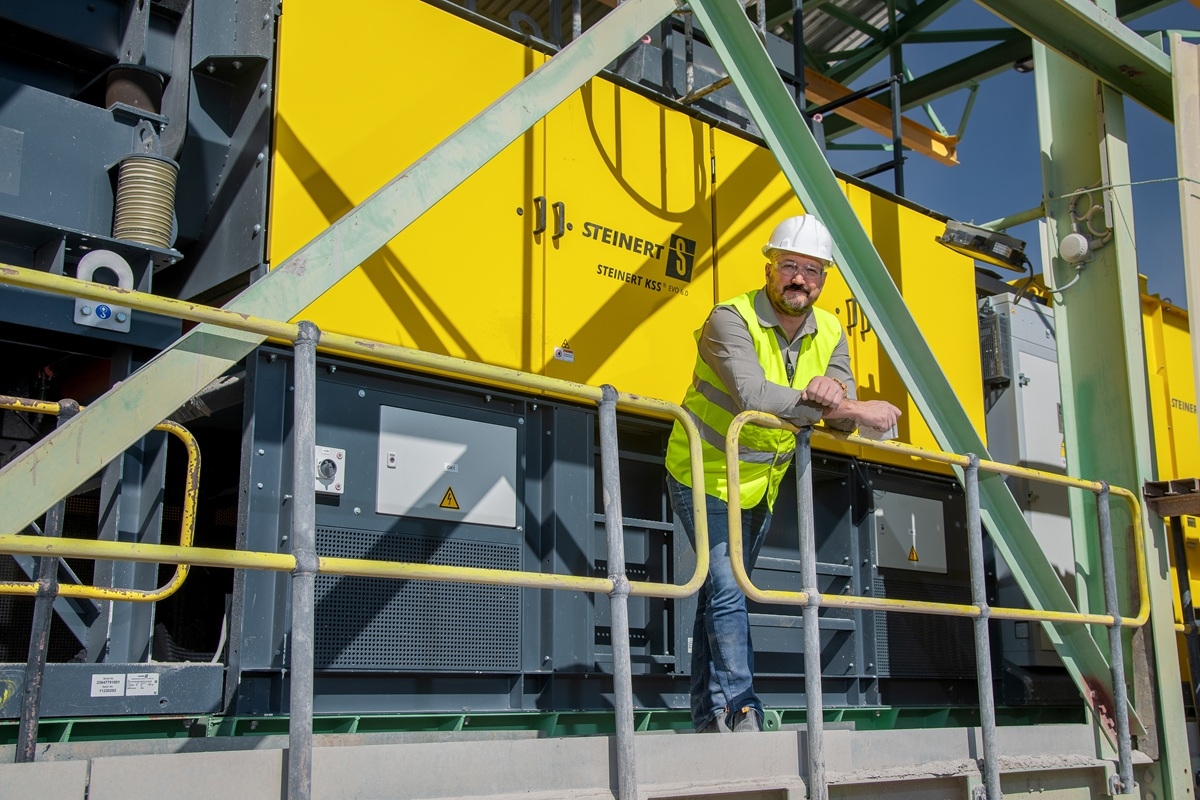 John Knouwds, STEINERT’s mining expert in Namibia, is responsible for the project at Navachab Gold Mine where the new “STEINERT KSS EVO 6.0” generation has been successfully installed
© STEINERT
This statement is a compliment to STEINERT’s engineers – for their ability and desire to explain technology and share knowledge, for example John Knouwds, STEINERT’s Solution Manager in Mining. John Knouwds has also been in the mining business for a very long time and first crossed paths with Hildebrand Wilhelm as a student 25 years ago. ”Having somebody available that can help develop your thoughts and that you can bounce ideas off helps a lot.” Hildebrand Wilhelm would never support an idea which he does not understand the science behind. As STEINERT’s detectors developed, the opportunity was taken to test the Navachab ore response to a combination of sensors in order to improve gold recovery. The testwork results indicated that improvements were possible and when the time finally came to replace the single-sensor machine, it was decided to incorporate the new technology.
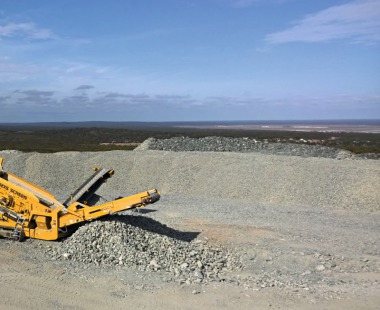
 After the low-grade stockpiles are processed in the pre-concentration plant, the material has doubled its grade
© STEINERT
Sensor-based sorting combined with Intelligent.Declustering for more throughput
STEINERT has a new solution in the field of data interpretation. Particle sorting technology typically analyses and makes decisions regarding individual defined particles on the conveyor belt. When increasing throughputs, there is a higher chance for composite objects to be identified as only one particle. This can result in incorrect sorting decisions such as valuable ore being classified as waste, or waste being classified as a valuable material.
During the gold ore detection process, declustering ensures individual particles are detected separately for proper classification. This feature improves the accuracy and efficiency of the sorting system, while allowing higher throughputs to be processed. With STEINERT's Intelligent.Declustering, the software extracts the individual rock from the cluster, even if the particles are very close together, and analyses it. The benefit of this process is that it now makes goals which were previously mutually exclusive compatible. Besides this, it is possible to upgrade existing units, quickly and easily.
 With STEINERT's Intelligent.Declustering, the software extracts the individual rock from the cluster, even if the particles are very close together, and analyses it. This results in a higher throughput
© STEINERT
STEINERT KSS EVO 6.0: easy to maintain, time-saving and safe
The concept of the STEINERT KSS itself is not new. What’s new is that the Navachab Gold Mine has opted for a multi-sensor sorting solution and is now benefitting from updating the STEINERT KSS to the EVO 6.0 version. Regular maintenance keeps performance at the highest level and reduces wear, and the EVO 6.0 generation significantly improves sorting system handling. The operator can simply walk into the machine to inspect it and the integrated rolling platform permits quick and safe access to the valve bar and conveyor belt. Better access to the system components speeds up maintenance work.
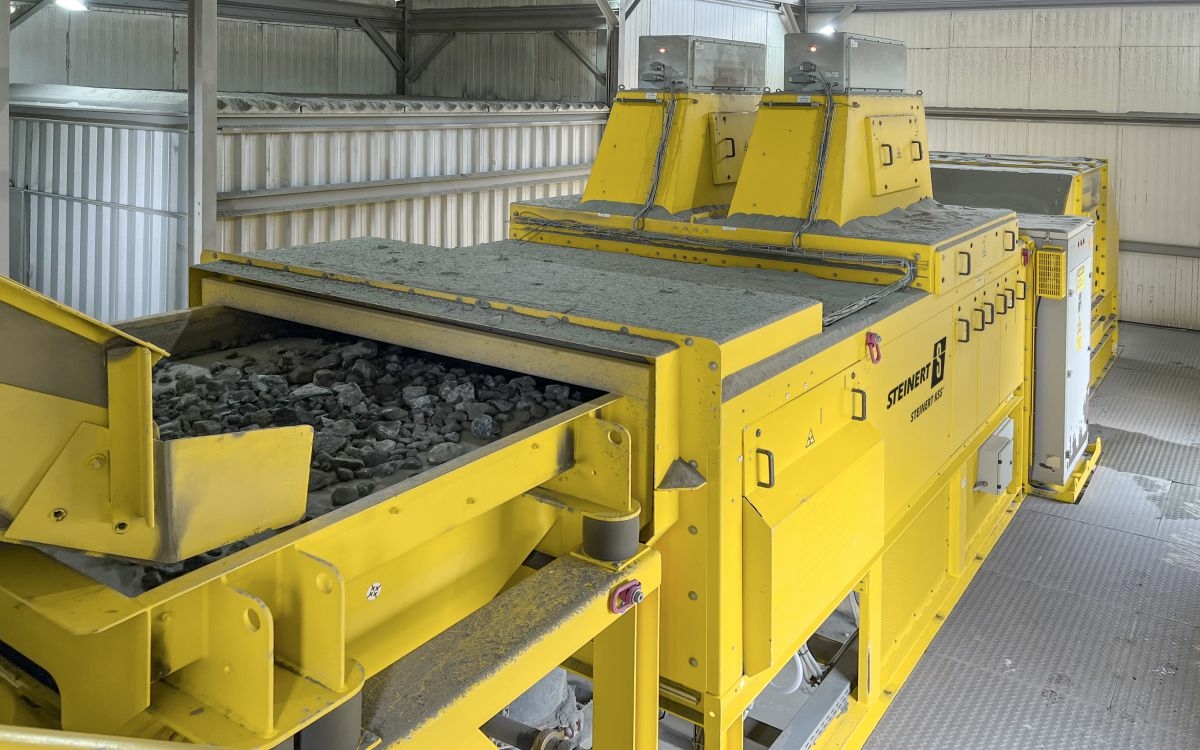
During sorting, the valve bar ensures that the sorted material is ejected. To prevent the valve bank from becoming clogged during maintenance work, the valve bar can now be swung up. The pneumatic unit has also been re-arranged and is easy to access. The operator also benefits from a permanently integrated railing with ladders, allowing the 3D and colour sensors to be accessed quickly and safely without requiring climbing gear.
 Compressed air extracts the waste from the product. To prevent the valve bar from becoming clogged during maintenance work, the valve bar can now be swung up
© STEINERT
Profitability comes with responsibility
“We are now working to ensure that the mine has a very long life. One of the big concerns is how to empower the youngsters who are going to take over from us. We are supporting schools and universities and giving bursaries to people. Navachab will carry on running as long as we are smart about things,” says Hildebrand Wilhelm at the end of the visit. “After all, the gold is there.” After an hour of sharing his thoughts, he makes a prediction: “In 25 years there will be sorting technology in every processing plant because sorting technology is the cheapest technology of all the technologies that are available in terms of operating costs. Ore bodies are becoming lower in grade, meaning sorting will only gain in importance.”