
Long-term benefits

Mitigating dust with conveyor belt cleaners
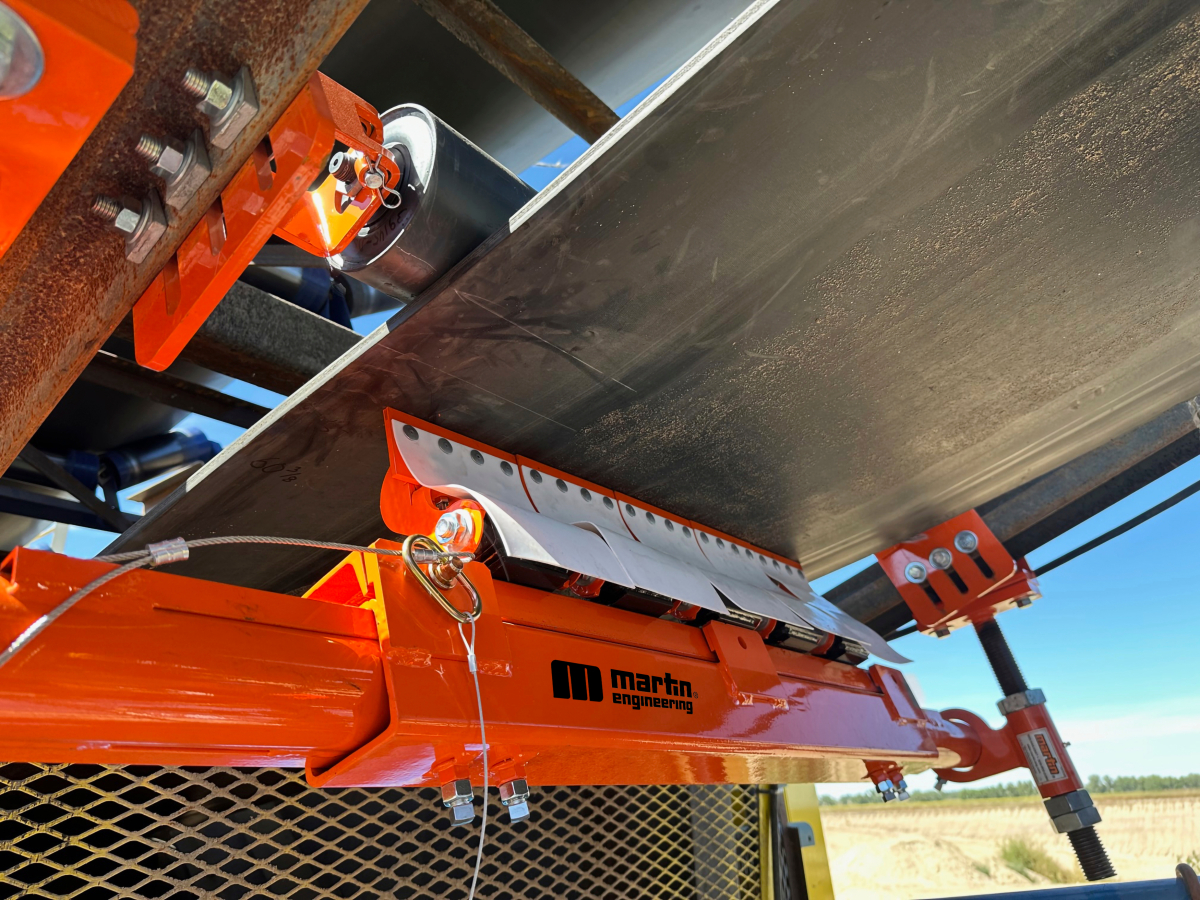
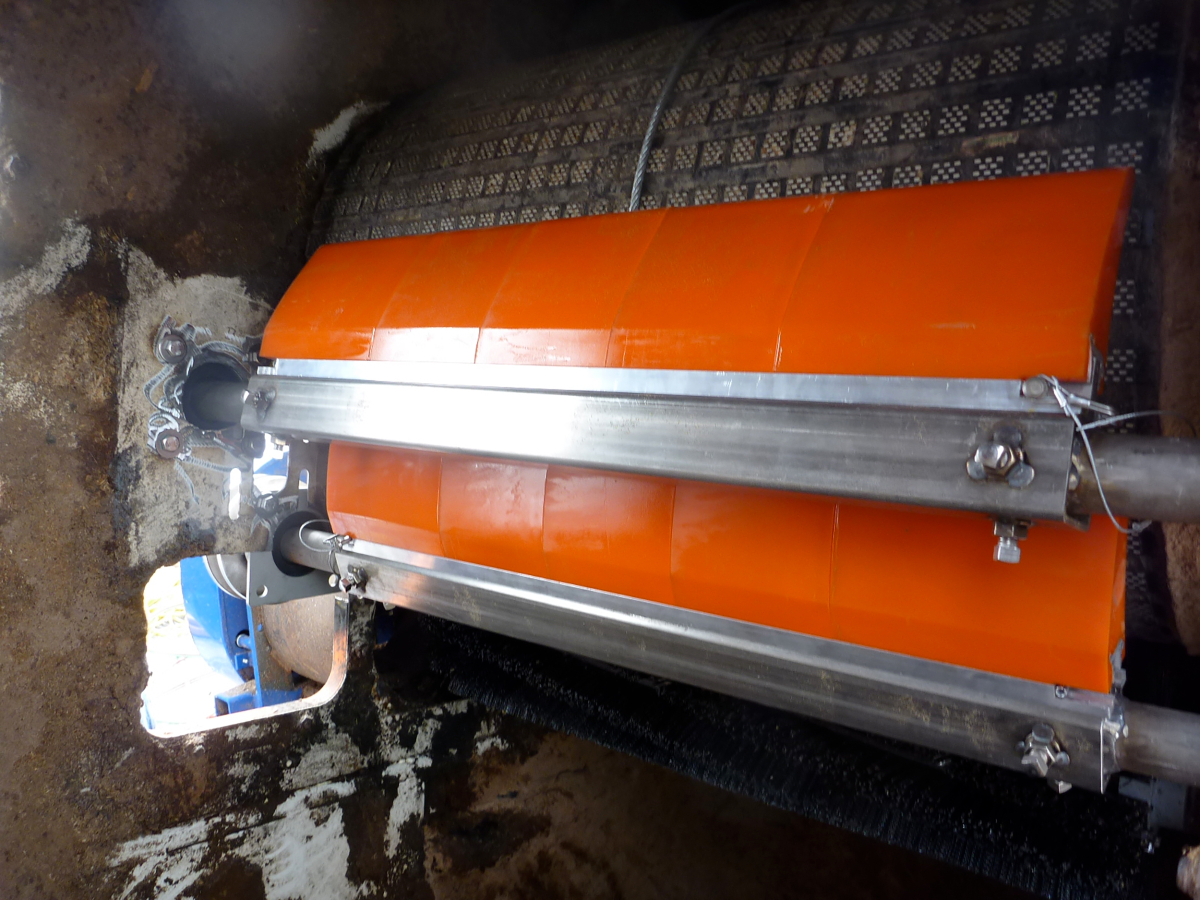
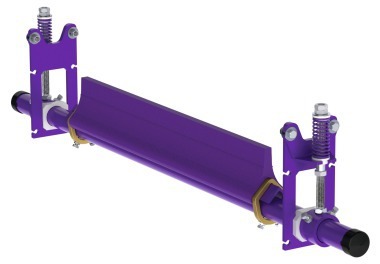
Summary: The ongoing battle against dust in bulk material handling is a continuous challenge. The location and number of belt cleaners required, based on production volume and application on a conveyor system, are closely tied to safety, emissions, and operating costs. A common design challenge is positioning belt cleaners in the optimal locations. Structural, spatial, and safety access considerations can create limitations. The configuration of discharge chutes and the installation of a dribble chute to capture extra discharge may also need to be factored into the design. This article will discuss design calculations for the placement of secondary cleaners (Fig. 1).

CEMA recommendations on placement and positioning

The Conveyor Equipment Manufacturers Association (CEMA) defines the secondary position as the space between the head pulley and the snub pulley on the return run of the belt (Fig. 2). Unfortunately, structural designs often result in a very short section of belt surface between the head pulley and the snub pulley, which is the ideal location for many secondary cleaner designs. This limited distance leaves little room for belt cleaners in the secondary position, which is further complicated by the space needed for a dribble chute. Additionally, designers often place work platforms based on major components, overlooking access for belt cleaner inspection or maintenance. Belt cleaners typically require more attention than major components to ensure system efficiency because the blades are wear components that must be maintained at optimal cleaning pressures.


Design and installation considerations

There are many simple options designers should consider:


Is the drive pulley wrap angle really needed or is it just used out of habit? 

A common default wrap is 210°, created by the position of the snub pulley. The gap between the head pulley and snub pulley is an ideal location for a secondary cleaner, but the combination of pulley diameters and wrap angle may make mounting a secondary cleaner difficult and maintenance nearly impossible. We recommend utilizing an updated engineering design program that uses either the DIN or CEMA methods for calculating accurate tension values and the required wrap angle, Θ.


Using a larger diameter head pulley

Choosing a head pulley based on the minimum diameter may seem like it saves money, however, MSHA reports that up to 85 % of maintenance problems are due to fugitive materials, which increase costs for cleanup, labor, and equipment replacement [1]. A larger head pulley can allow the installation of two cleaners in the primary position and enough snub pulley space for one or two cleaners in the secondary position, significantly reducing the amount of fugitive material (Fig. 3).


Ergonomic access to the belt cleaners

Maintenance personnel can spend up to a third of their time simply gaining access to equipment. Designing access to seldom-inspected or -maintained components based on minimum walkway codes increases costs. Consider structures and work platforms that facilitate belt cleaner inspection and maintenance. 


Using motorized drive pulleys

Motorized pulleys offer energy advantages and weight savings and open up space for belt cleaner installation and maintenance. Since all rotating components (including the main bearings) are located inside the pulley, the external stub shafts need minimal space to be mounted to the structure.


Professionally trained installation

Belt cleaners must be mounted accurately, typically within a few millimeters, to operate optimally and reduce the risk of damaging the belt. Partnering with the belt cleaner supplier guarantees proper installation with minimal adjustments and ensures that the new chute maintains a clean, professional appearance.


Calculating the adequate belt tension

A critical design requirement is to determine the amount of wrap around the drive pulley necessary to ensure adequate torque conversion from the drive into belt tension sufficient to move the belt without slipping. It is interesting to note that the fundamental relationship describing this transfer does not depend on the pulley diameter, but rather on the coefficient of friction, µ, between the belt and pulley, the wrap angle, Θ, and the belt tensions required to prevent slip (Fig. 4).


Secondary belt cleaner location geometry

Assumption: Top and bottom runs of the conveyor belt (X) are parallel entering head pulley and leaving snub pulley (Fig. 5).


Variables:

Θ = Wrap angle of belt around head pulley

ω = Wrap angle, Θ, – 180°

H = The height of the opening for the Secondary belt cleaner blades and frame installation

Rh = Radius of Head pulley plus lagging, plus belt thickness

Rs = Radius of Snub pulley plus lagging, plus belt thickness (Snub Pulley Diameter default value: 0.64 × head pulley diameter per DIN 22101)

T = The width off the opening for the Secondary belt cleaner blades and frame installation

W = Length of belt segment tangent to both the Head and Snub pulleys

X = Distance between top and bottom runs of the conveyor belt

Y = The vertical distance between the top run of the conveyor belt on the Head pulley and the tangent point where the belt leaves the Head pulley and starts the return run


Some secondary cleaners must be installed at least 50 mm from the point where the belt leaves the head pulley, so this offset should also be considered if needed. Additionally, the X dimension must be verified against the idler dimensions to ensure sufficient installation space (Fig. 6).


A similar analysis of the placement of precleaners indicates that with a 1200 mm diameter head pulley, two primary cleaners can be installed alongside a secondary cleaner. The inclusion of tertiary cleaners is possible, but may not be necessary if two precleaners and a secondary are mounted on the head pulley.


Conclusion

A belt cleaner system should be properly specified, designed and installed to gain the direct and indirect long-term cost benefits of reduced fugitive material, but compliance is an issue as well. OSHA, 1926.1412(d)(1) and MSHA 75.362 state: “A competent person must begin a visual inspection prior to each shift the equipment will be used, which must be completed before or during that shift [2].” Safe access with adequate space for installation, maintenance and inspection is critical to supporting longer system life and a lower cost of operation. 

Literatur • Literature

[1] 2014 Pit and Quarry Operations Handbook, Chapter 10, p. 145

[2] Occupational Safety and Health Administration (OSHA), “§ 1926.1412 Inspections”,

Dec, 2023. https://www.ecfr.gov/current/title-29/subtitle-B/chapter-XVII/part-1926/subpart-CC/section-1926.1412

x

Related articles:

Issue 07-08/2022 Effective belt cleaning

Managing conveyor belt carryback

Carryback is defined as the material that fails to unload from a conveyor belt, adhering to the belt and typically falling off at some point other than the intended discharge, and it’s one of the...

more
Issue 06/2014

Absolutely clean conveying

Operators of conveyor systems, such as those used in coal mining, underground mining, steelworks or wood processing, require optimum efficiency for cleaning of the belts. Very good results can often...

more
Issue 03/2018 A flair for fine cleaning

The Y-type secondary cleaner by Flexco guarantees outstanding cleaning performance

Material carryback is one of the main causes of potential problems in belt conveyor systems. To prevent this, operators rely on precleaners for coarse materials and secondary cleaners for fine...

more
Issue 03/2023 Options for safe, efficient operation

Choosing suitable conveyor belt cleaner tensioners

There are many issues to consider when specifying the most appropriate conveyor belt cleaner, not the least of which is maintaining proper tension to achieve optimum cleaning performance without...

more
Issue 11/2025 Automated monitoring

Servicing the conveyor cleaning blade

The need for conveyor belt cleaning is well established. Excessive fugitive material can reduce component and belt life by as much as 30 %.?A multiple belt cleaner system accounts for less than 5 % of...

more